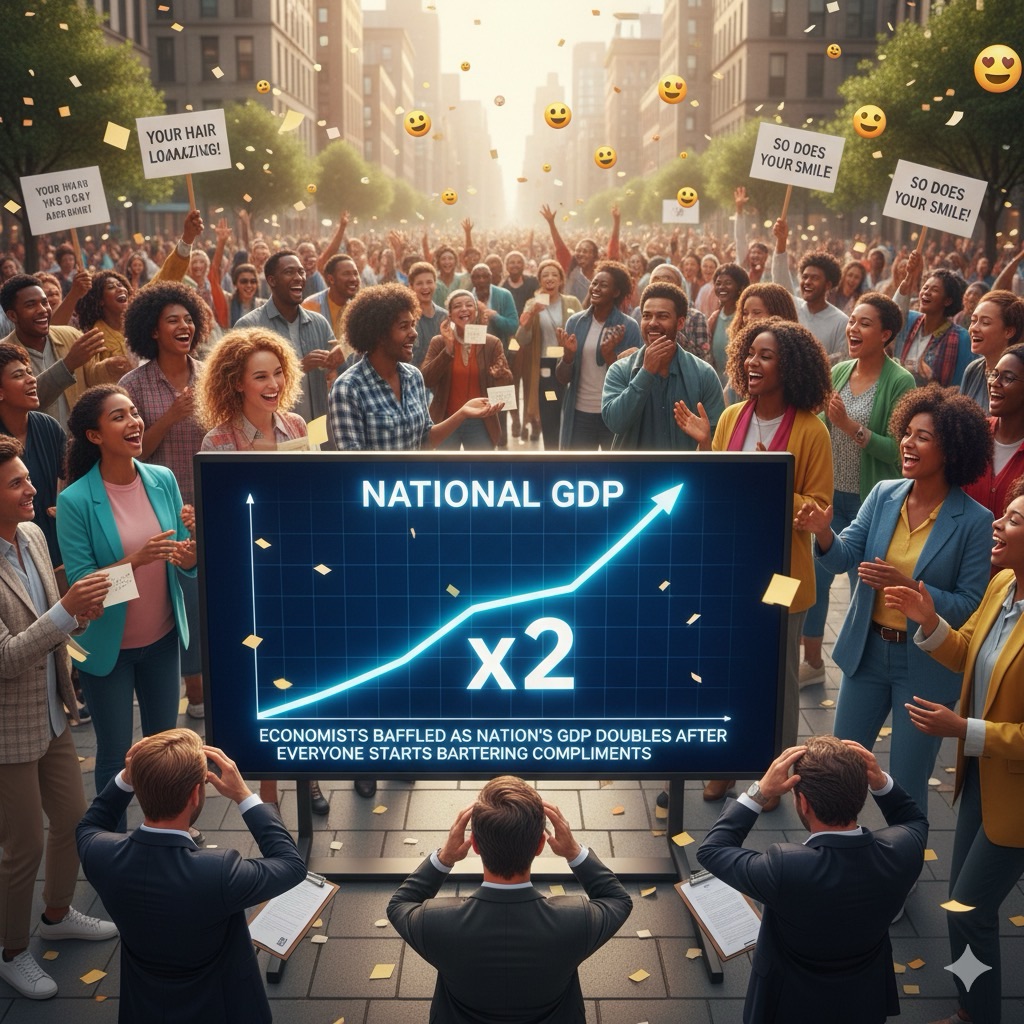
Antarctica City, Thursday — In an unprecedented economic surge that has left financial experts dazed, delighted, and mildly offended, the nation’s GDP has reportedly doubled within a week—without a single new factory, tax reform, or spreadsheet update. The cause, according to officials at the Ministry of Peculiar Prosperity, appears to be the population’s enthusiastic adoption of a new barter system based entirely on compliments.
The movement began innocuously when a local café owner, tired of inflation and small coins, began accepting “sincere flattery” in exchange for cappuccinos. “One customer told me I had ‘the confidence of an espresso and the warmth of a latte,’ and I just couldn’t charge him,” said owner Freya Bloom, whose café is now a recognized financial institution. “Since then, I’ve had people comparing my croissants to sunsets and my scones to spiritual awakenings. It’s been profitable—emotionally and, apparently, economically.”
Soon after, other businesses followed suit. Plumbers were paid in praise (“You wield that wrench like Michelangelo with a spanner”), lawyers in admiration (“Your objection had the moral clarity of a Shakespearean soliloquy”), and accountants in something approaching reverence (“You make balance sheets feel like poetry”). By midweek, the national statistical office found itself in crisis when GDP appeared to have doubled—not in cash, but in self-esteem.
Economist Dr. Lionel Bramble of the Institute for Abstract Economics admitted defeat. “Traditional models simply don’t account for this,” he confessed, riffling through visibly irrelevant charts. “We’ve always assumed value must be measurable in currency or goods. No one ever thought to include ‘Karen telling Martin he has an impressive moral aura’ as an economic transaction.”
The central bank, initially skeptical, is now considering introducing a new unit of exchange—the Complimentary Credit—pegged loosely to “the emotional weight of a really good compliment from someone you barely know.” Early prototypes of digital wallets are already in testing, allowing citizens to send voice-note affirmations with exchange rates fluctuating depending on sincerity and poetic flair.
However, not everyone is thrilled. Critics warn of inflation in the “compliment economy,” as people begin giving lavish praise merely to settle debts. “Yesterday, a man told me my elbows radiated leadership potential,” said one exhausted citizen. “It was flattering, but also deeply suspicious.” Black markets have reportedly emerged where insincere compliments—known colloquially as “flattercoin”—are traded at steep discounts.
Meanwhile, international observers remain confused. The World Bank called the phenomenon “an extraordinary demonstration of confidence,” before clarifying, “no, literally—confidence is now a recognized economic asset there.” Neighboring countries have begun trial runs of similar systems, though early results are mixed. In Finland, a pilot project collapsed after citizens refused to exaggerate.
Asked whether the boom is sustainable, Finance Minister Aurelia Finch offered a beatific smile. “Perhaps not,” she said. “But for now, the people are richer in kindness, poorer in cynicism, and statistically more radiant.”
Markets closed the day up 400 points, largely due to traders telling each other they looked great doing it.
